February 2026 market update
Canada Life - Mar 06, 2026
February was defined by tensions, tariffs, trade talk and shifting rate paths. See how these events filtered through markets.
Introduction
At the end of February, the U.S. and Israel attacked Iran as tensions escalated between the two sides. Iran responded by sending missiles to points in Israel and U.S. bases in the Middle East. Amidst the strikes on Iran, the country’s Supreme Leader, Ali Khanenei, was killed. Fears of escalating tensions could weigh on global financial markets, and the effective closure of the Strait of Hormuz could disrupt the flow of crude oil globally.
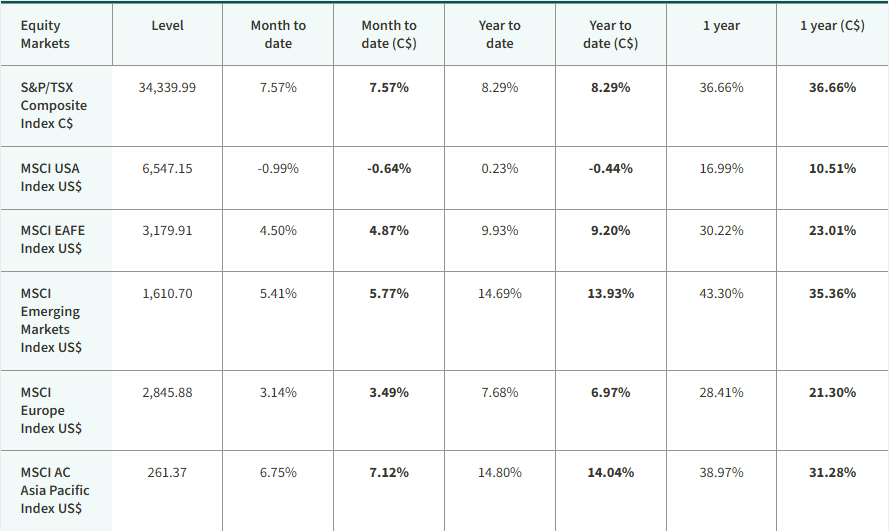
Global equity markets inched higher over the month of February. Strong corporate earnings offset concerns about artificial intelligence spending and reemerging trade uncertainty. Still, returns were muted and saw bouts of volatility over the month. It was reported that Canada’s economy contracted in the fourth quarter of 2025 and shed jobs in January. However, inflationary pressures did subside at the start of 2026.
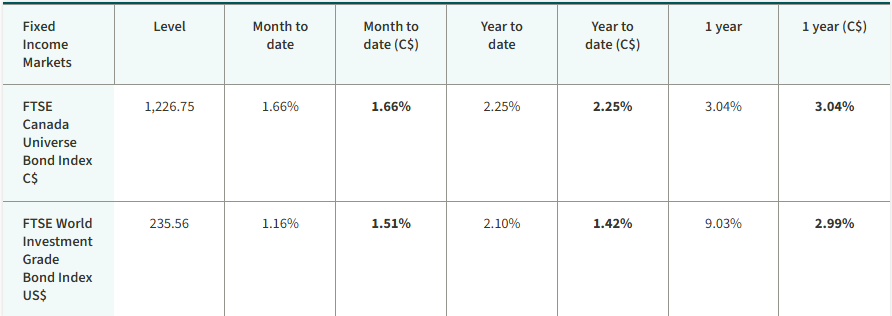
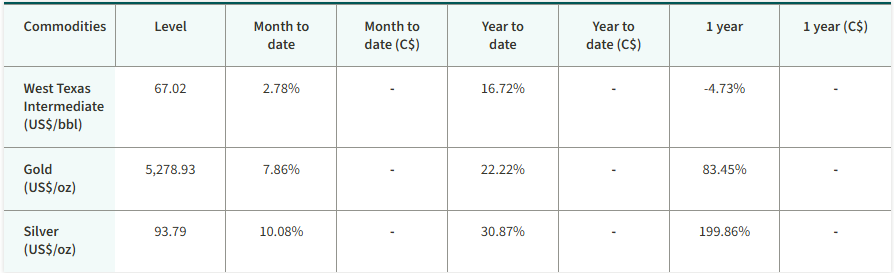
The S&P/TSX Composite Index delivered a strong return over the month, reaching new record highs. U.S. equities posted a small decline. Yields on 10-year government bonds in Canada and the U.S. declined. Oil prices finished higher over the month, as did the price of gold.
New U.S. tariffs imposed after Supreme Court’s decision
U.S. President Donald Trump was dealt a major blow to a key policy piece of his economic agenda when the U.S. Supreme Court voted down his use of emergency powers to impose “Liberation Day” tariffs on much of the rest of the world. The decision was met with displeasure by Trump, who did not agree with the decision and believed it would weaken the American economy. However, the U.S. administration turned to Section 122 of the 1974 Trade Act, which allowed it to impose a baseline tariff on U.S. imports. The baseline 10% tariff went into effect on February 24, with the U.S. administration attempting to raise it to 15%. The new baseline tariff may not have much impact on Canada. It was announced that products under the Canada-United States-Mexico Agreement (CUSMA) would remain exempt from the tariffs. The ruling was expected to lower the effective tariff rate on Canada and Mexico.
The decision and immediate implementation of new tariffs reignited uncertainty about trade and global economic activity. U.S. Trade Representative Jamieson Greer said he had spoken with Canadian officials, who had some ideas on reaching a trade agreement with the U.S. Discussions are set to begin in the upcoming weeks. There remains some uncertainty around CUSMA, however. Reports have shown that Trump is considering tearing up the agreement. CUSMA review appears likely to begin this summer.
Uncertainty continues to grip Canada’s economy
Late in February, Statistics Canada reported that Canada’s gross domestic product shrank by 0.6%, annualized, in the fourth quarter of 2025. Despite the contraction, underlying data suggests economic activity remains relatively solid. The fourth-quarter decline was mainly driven by a sharp fall in business inventories. Business capital investment also declined over the quarter. Conversely, household spending increased over the quarter, as did exports, which rose by 1.5%. Economists saw the report as largely positive given the drop was isolated to business inventories, which may not be an ongoing detractor from economic growth. Furthermore, the Bank of Canada (BoC) expected the economy to pull back in the quarter.
While exports increased, trade activity was relatively muted in response to trade disruptions with the U.S. Trade tensions continue to create uncertainty among consumers and businesses. The BoC, too, expressed concerns that sudden and regular shifts in U.S. economic policy measures are making it tougher to make monetary policy decisions. Thus, it was difficult for BoC officials to predict the path of interest rates for the months and quarters ahead. Markets expect the BoC to hold its benchmark overnight interest rate steady at its March meeting, with inflation and the Canadian economy largely progressing in line with the central bank’s expectations.
Has the U.S. labour market solidified?
Data released in February shows that the U.S. labour market may have solidified in January, at least temporarily easing concerns about the job market. The U.S. economy added 130,000 jobs in January, the most in a month since December 2024. Strong job gains were seen in the health care and construction industries, which offset job losses in the financial activities industry. Helped by a decline in the number of unemployed persons and rising total employment, the unemployment rate edged lower to 4.3% in January from 4.4% in the previous month. This marked the lowest jobless rate since August 2025.
Over February, initial jobless claims ran at levels lower than those posted over 2025. Combined with easing inflationary pressures, data points to the U.S. Federal Reserve Board (Fed) potentially holding its federal funds rate steady at a target range of 3.50%–3.75% in March. However, a few Fed officials are wondering whether the labour market strength in January will continue, or if the strong job gains are temporary. With trade policy changing and geopolitical tensions in the Middle East heightening, the Fed will need to carefully analyze the impacts of its monetary policy on the U.S. economy ahead of its upcoming rate decisions.
Major central banks in Europe hold interest rates steady
Across the Atlantic, two major central banks in Europe elected to hold their policy interest rates steady at their first meetings in 2026 in February. The European Central Bank (ECB) kept its three main interest rates steady at its February meeting. The ECB’s main refinancing rate still stands at 2.15%. Europe’s central bank believes its interest rates are at an appropriate level given that inflation is close to its 2% target. However, the ECB cautioned that there is still much uncertainty around its outlook, which was heightened by the U.S. Supreme Court’s decision, which resulted in the European Union (EU) halting the ratification process for a trade deal with the U.S. EU officials are looking for more legal clarity on the ruling and how it impacts the trade terms of its deal with the U.S.
Meanwhile, in the U.K., the Bank of England (BoE) left its key interest rate unchanged at 3.75% at its February meeting. It was another narrow vote by BoE officials, who are struggling to come to a consensus amid still-high inflation and lacklustre economic activity. Furthermore, the BoE has acknowledged several risks to its outlook, which could weigh on economic conditions.
Market performance - as of February 28, 2026

This commentary represents Canada Life Investment Management Ltd.'s views at the date of publication, which are subject to change without notice. Furthermore, there can be no assurance that any trends described in this material will continue or that forecasts will occur; economic and market conditions change frequently. This commentary is intended as a general source of information and is not intended to be a solicitation to buy or sell specific investments, nor tax or legal advice. Before making any investment decision, prospective investors should carefully review the relevant offering documents and seek input from their advisor. You may not reproduce, distribute, or otherwise use any of this article without the prior written consent of Canada Life Investment Management Ltd.